

CHESS vs Custodian Accounts for SMSF Share Investing
It is common for SMSFs to use a CHESS-sponsored or custodial model to acquire listed shares on the Australian Stock Exchange (ASX), the National Stock Exchange of Australia (NSX) and CBOE Australia. One of the most significant differences is that the CHESS-sponsored model provides direct ownership of listed shares by an SMSF, whilst under the Custodian model, the shares are legally owned by a custodian and not directly by the SMSF.
Why does legal ownership matter?
Under Regulation 4.09A of the superannuation regulations, an SMSF auditor must verify the ownership of an SMSF’s assets and their separation from the personal assets 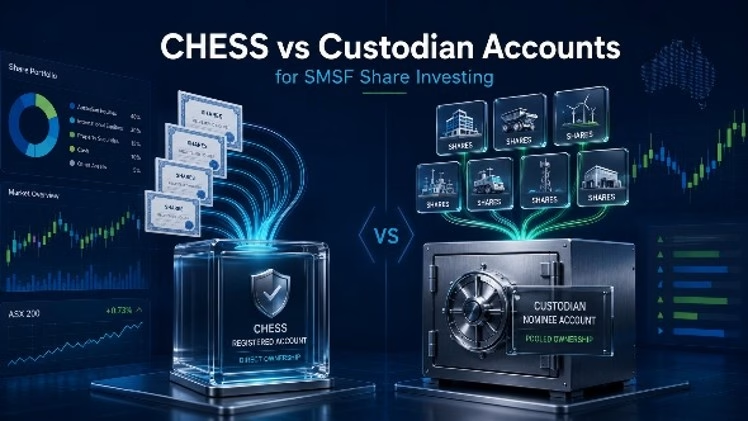 of the SMSF’s trustees or the directors of a corporate trustee. The auditor can confirm the fund’s ownership of assets held directly with third-party share registries through a funds Holder Identification Number (HIN). Under a CHESS arrangement, the fund’s name appears on the share title, making ownership easy to verify. However, when investments are made via an investment platform, wrap account or Investor Directed Portfolio Services (IDPS), they are held under the name of the custodian, and an SMSF auditor cannot directly verify the fund’s ownership.
What will the SMSF auditor do if the assets are held by a custodian?
Verifying ownership is particularly difficult when the shares are beneficially owned by the fund but legally held by another entity, the custodian. An SMSF auditor will generally qualify Part A of their audit report when the fund assets are held by a custodian unless they have done sufficient testing of the custodian. This is not considered a bid deal and merely indicates the auditor has relied on the reports provided and has not audited the underlying custodian organisation’s records.
The SMSF auditor will also require the platform to have a Type 2 Audit Report testing the design, implementation, and effectiveness of the platform’s internal controls. Auditing standards require direct testing of the platform’s transactions to satisfy that sufficient and appropriate audit evidence has been obtained before an unqualified audit report can be issued. However, testing the platform’s transactions would be time-consuming, expensive and, in most cases, inaccessible. A Type 2 Report, along with other data, such as confirming income to third parties and the fund’s bank transactions may be helpful for the SMSF auditor to satisfy that the income, expenses, asset acquisitions and disposals are recorded correctly.
What is a CHESS-sponsored arrangement?
CHESS stands for the Clearing House Electronic Subregister System and is the ASX’s electronic system for recording share ownership and settling share transactions. When an SMSF enters into a CHESS-sponsored arrangement with a broker, the broker sponsors the fund’s use of CHESS and issues a unique Holder Identification Number (HIN), which usually starts with an ‘X” followed by 10 digits.
What does the broker do?
The CHESS-sponsor arrangement allows the broker to buy or sell shares on the SMSF’s instructions. The fund has legal and beneficial ownership of those shares. The title to the fund’s shares can be accessed via the share registry for a specific share; for example, BHP shares are held with Computershare, and Westpac shares are held with MUFG Corporate Markets Ltd. The fund’s broker will provide copies of all contract notes (which are copies of the trade orders), transaction statements, and a portfolio statement showing the shares held by the fund for all holdings under the same HIN, as well as the portfolio’s holding and valuation.
What is a Custodial arrangement?
When an SMSF invests in an investment platform with a custodial arrangement in place, the assets are held legally by the custodian, a separate legal entity from the platform itself, and regulated by ASIC. The custodian will have a HIN as it is the legal owner of Australian equities. No HIN is provided to the SMSF as the fund has no direct ownership. Share registries will not show the fund as the owner.
Shares are held in a pooled account by the Custodian. Behind the scenes, the platform administrator is responsible for maintaining accurate records that show an investor’s entitlement to part of the pool and details of purchases, disposals and income. The administrator will settle share transactions, pass on dividends to the investor, and generally handle corporate actions and elections, including enrolling in a dividend reinvestment plan, though this may vary between platforms. Voting rights are exercised directly by the Custodian. However, platforms can pass voting materials to the underlying SMSF investor and execute the fund’s authorised voting instructions, though not all do so.
Advantages and disadvantages of a CHESS-sponsored arrangement for an SMSF
Advantages of a CHESS-sponsored arrangement include:
- Direct legal ownership of the assets by the SMSF, allowing the fund or the fund’s auditor to confirm shareholdings directly through a company’s share registry.
- All of the fund’s trading transactions are linked to a single HIN, centralising record keeping, and if changing brokers, the HIN can also be transferred and does not trigger a CGT event.
- The SMSF can exercise voting rights.
- All correspondence is sent directly to the SMSF.
- The CHESS broker provides the fund with trading transactions and portfolio statements.
- Direct data feeds with specialist superannuation software such as CLASS.
- Means no risk of a Part A qualification of your yearly SMSF audit report when compared to custodial arrangements
Disadvantages can include:
- Brokerage fees can be higher than custodial fees.
- Restricted to the Australian share market, CHESS cannot be used internationally or for unlisted managed funds.
- More paperwork for the SMSF.
- Unable to acquire fractional shares.
- Many brokers require a minimum investment, typically around $500.
Advantages and disadvantages of a Custodial arrangement for an SMSF
Advantages of a Custodial arrangement include:
- Custodians must be licensed, are regulated by ASIC and are required to keep investors’ assets separate from their own.
- Fractional investing is allowed by some platforms.
- Seamless investing with a single platform for both Australian and International shares.
- Lower fees are achieved when shares are acquired and sold in larger amounts by the platform as a pooled investment, allowing an SMSF to invest with lower minimum requirements.
- The platform administrator handles all administration related to shares acquired and sold by the SMSF, as well as processing dividends and transferring the cash back to the fund. The administrator prepares share trading and cash transactions, tax statements, and portfolio statements, and regularly sends reports to the SMSF. The fund will also have electronic access to data. Direct data feeds can generally be accessed via superannuation specialist software such as CLASS, enabling efficient, error-free data processing.
Disadvantages of a Custodial arrangement include:
- The custodian holds the legal title to the shares owned by the SMSF, and therefore, the auditor is unable to directly verify ownership.
- Restrictions on corporate actions and voting rights
CHESS-Sponsored broker platforms
Many broker platforms operate mixed models, using CHESS-Sponsored for Australian-listed equities and the Custodial model for international equities.
Popular CHESS-Sponsored broker platforms listed below operate mixed models:
- CommSec
- SelfWealth
- CMC Invest
Custodial investment platforms
Popular Custodial share platforms include:
- BetaShares Direct
- Interactive Brokers
- IG Markets
- Vanguard Personal Investor
- Superhero
What about security and risk management?
Both CHESS-sponsored and Custodial models are considered secure and low risk. Under CHESS, the SMSF’s holdings are directly recorded with the ASX, whilst the custodian model is highly regulated by ASIC. An SMSF undertaking either direct or indirect purchases of shares or other equities should review the relevant Product Disclosure Statement (PDS) or other relevant documents before making any investment decisions. Seek advice from the fund’s financial advisor to ensure the investment is right for the fund’s circumstances.
Recent legal proceedings include the infamous Caddick case, in which the Sydney fraudster ran an elaborate Ponzi scheme. The case involved low-risk listed shares and a genuine CommSec account. However, Melissa Caddick fraudulently altered documents. Other cases where investors lost money involved the BBY group and Halifax Investment Services. These were not failures of either model but resulted from fraudulent behaviour, intermingling investor money with the company’s own business, thereby funding the company’s losses and clouding the ability to identify investor entitlements.