

How to set up an SMSF ATO payment plan
 An SMSF with cash flow issues and a substantial tax bill may be able to set up an ATO payment plan. The fund’s accountant (tax agent) can assist you with this, or you can do it yourself online or call the ATO directly to arrange a payment plan. For clients of SMSF Australia this is something we assist our clients to organise with the ATO saving them the hassle.
What is an ATO payment plan?
It is an agreement between the ATO and an SMSF to make smaller, regular tax payments over a period of time, such as weekly, fortnightly or monthly, until the tax debt is fully resolved. Late payment of tax attracts general interest charges (GIC), which may continue to accrue, compounding daily, even while the agreement is in place. Any future tax debt must be paid when due.
How can my SMSF set up an ATO payment plan?
Your accountant can set up a payment plan through Online Services for Tax Agents, or you can do so using Online Services for Business, provided the fund owes less than $200,000 in tax.
Alternatively, if you cannot set up a payment plan by using Online Services for Business, the fund requires a timeframe for repayment exceeding 2 years, complex circumstances, or the debt exceeds $200,000, you can call the ATO business line at 13 72 26.
You will need proof of identity when you call the ATO, which can include:
- Your SMSF’s tax file number (TFN) or Australian business number (ABN)
- Your personal TFN, full name and date of birth and your residential or postal address
- Details from recent ATO letters or notice of assessment of your SMSF
How do I set up access to ‘online services for business’?
This is a three-step process, and further details can be found at myID.
Step 1. Apply for myID (this is not myGov)
Step 2. Link your myID to your SMSF by logging on to Online services for business, selecting ‘Continue with Digital ID’, and using the code sent to your selected email address; then, apply it to the myID app to access the online services. You then select ‘Relationship Authority Manager (RAM)’, enabling you to link myID to your SMSF.
Step 3. Sign out of RAM and go back to Online services for business to access your SMSF.
How to access an ATO payment plan online?
You can talk to the fund’s accountant, who can arrange an ATO payment plan, or you can do it yourself. We are happy to assist you with this process. Please contact us via the internet, email, phone or Zoom.
If you prefer to do it yourself and your SMSF tax debt is less than $200,000, you can access a payment plan by:
- Go to the webpage for Online services for business
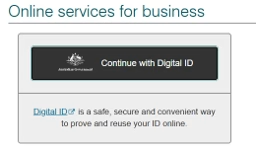
- Enter ‘Continue with Digital ID’
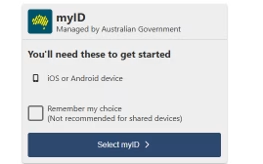
- Select your identity provider – complete the appropriate boxes and then ‘Select myID’
- Select ‘Get Code’ – the code appears on the myID website
- Follow the prompts and open the myID app on your phone
- Accept or enter the code on the myID phone app
- When the code is accepted, you can then access your SMSF account on the webpage for Online services for business
- Select ‘Accounts and payments’ from the SMSF menu

- Select ‘Payment plan’
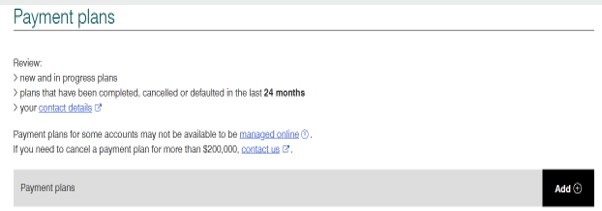
- On this screen, you can add a payment plan or review an existing one by selecting ‘Add+’. Selecting ‘managed online’ opens a help screen to assist you with queries, or press the ‘help’ button on the side. Follow instructions as appropriate.
Setting up a payment plan online
Provided your SMSF is eligible and has a debt of less than $200,000, you can set up a payment plan online.
- The ATO will require an upfront payment -the amount can vary but is generally between 5% – 10% of the outstanding tax liability.
- GIC continues to accrue daily until the debt is fully repaid.
- Separate payment plans are required for overdue tax amounts for income tax and integrated client account taxes (ie GST and PAYG instalments).
- Additional voluntary payments can be made, and the final balance can be repaid early.
- Future tax liabilities and lodgements must be met by the required time, including nil returns.
Making a payment plan by accessing an ATO payment plan online using ‘Online services for business ’ and selecting the following:
- Accounts and payments.
- Payment plans and ‘Add+’ to start a new plan for a specific tax debt.
- Type of Account – only tax accounts or activity statement accounts that have an eligible outstanding debt will be available.
- Amount – if the account balance includes a current debt that is not due, you can choose to include the total balance or just the overdue amount.
- Payment Method – setting up a direct bank debit for an SMSF is preferable to ensure the instalments are paid on time and are not missed – need to ensure it is cancelled when the debt is fully repaid.
- Frequency of Payment -can be lump sum, weekly, fortnightly or monthly.
- Payment Date – must be made within 7 days (excluding weekends and public holidays) of the plan starting – an upfront payment is required, and the program will automatically populate the upfront amount as well as the instalment amount. The fields can be amended to suit the fund. An error message will flash up if the parameters do not meet the ATO’s requirements. The system will automatically include applicable GIC.
- Calculate the Payment Plan – this is displayed on screen, and adjustments can be made before completing the plan.
- Select the Declaration and Submit the plan – confirmation will be received, and you can print a copy of the payment schedule as well as save a copy electronically.
Hint – An online ATO payment plan estimator lets you vary inputs such as repayment periods, instalments, and upfront payments, and calculate the applicable GIC to help you work out a suitable plan.
SMSF eligibility to set up a payment plan
The ATO does not guarantee that your SMSF will qualify for a payment plan. It will assess eligibility based on the following factors:
- All of the fund’s lodgements for SMSF annual returns and Business Activity Statements (BAS) must be up to date.
- What is the reason the fund is unable to meet the tax payment – for example, short-term cash flow issues may mean the fund has to sell an illiquid asset, or expected contributions or income have been delayed?
- Repayment terms offered should be over a reasonable timeframe, not more than 2 years, and the future instalments can be sustained.
- The fund’s lodgement compliance history is reviewed.
- Lack of engagement with the ATO by ignoring previous correspondence.
- Are there any other options for dealing with the tax debt, i.e. varying a PAYG instalment down?
What taxes can my SMSF pay via an ATO payment plan?
Your SMSF can make a payment plan for the following taxes:
- Income Tax
- GST, PAYG instalments and PAYG withholding tax
What is GIC?
The General Interest Charge (GIC) is an interest penalty applied by the ATO to unpaid tax liabilities and overdue amounts. It is calculated on a daily compounding basis on the overdue amount. The interest rate is variable and updated quarterly, based on the 90-day Bank Bill rate plus a small margin. The current rate for the December 2026 quarter is 11.51% p.a.
Is GIC tax deductible by your SMSF?
The GIC incurred on or after 1 July 2025 is not tax deductible. GIC in relation to, say, the 2024/25 year but not charged until, say, 20 August 2025 is not tax deductible. The flip side is remittance of GIC after 1 July 2025 in relation to, say, 2024/25, or earlier years, is not assessable income.
How to manage the fund’s payment plan?
You can change how your SMSF pays, amend instalments, or check the status of the fund’s plan via ‘Online services for business’ or by calling the ATO on its business line. However, instalments cannot be changed if doing so would extend the timeframe beyond 24 months. The ATO allows some leniency, provided the SMSF responds to ATO arrears letters and catches up on any outstanding instalments. If a default occurs, the whole overdue amount is immediately payable, and the ATO may take legal action to recover the debt, which could be detrimental to a fund holding a single non-liquid asset, such as a commercial property or a private unit trust with limited buyers.