

SMSF Borrowing Rules
 Previously, self-managed super funds were permitted to borrow, but only in certain short-term situations. The introduction of Limited Recourse Borrowing Arrangements (LRBAs) in 2007 changed this, allowing SMSFs to borrow for medium to long term periods. The superannuation rules were updated again in 2010 with the inclusion of SIS s 67A, and again on 10 August 2026, limiting property acquisition to business real property (BRP). The government ban on residential loans does not impact existing LRBAs. An SMSF can still acquire eligible residential property, provided it can pay for it from fund cash resources and does not require a loan.
The attractiveness to take out a loan by a SMSF include:
- increasing investment capital as contributions caps have limited the amounts that can be contributed to a superannuation fund
- the ability to purchase an investment property used in the member’s business where existing fund capital is not sufficient so that the SMSF would need to borrow funds to make up the shortfall
- using a lending institution or a related party lender if a SMSF needs to borrow for a property purchase
- the asset is able to be used as security for the borrowing
- using a LRBA restricts the lender’s recourse in the case of a default on the loan to the asset under the arrangement
Nevertheless, there are numerous regulations that must be adhered to in order to properly address legal and compliance issues.
We highly recommend advice be sought from a SMSF Specialist before contemplating using a LRBA.
Short-Term Borrowing Rules
A SMSF can borrow money for a short period up to 10% of the fund’s total assets for the following purposes:
- to pay a benefit payment or an outstanding surcharge liability for a maximum of 90 days
- to settle security transactions which provides a maximum of seven days to cover the settlement. This comes with a rider that the borrowing is only for an unforeseen circumstance.
The rules applying to short-term borrowing are very limited.
Borrowing to Invest using a Limited Recourse Borrowing Arrangement (LRBA)
An overall rider is the borrowing is used to acquire an asset which is permitted by the SIS rules and regulations.
A summary of the rules in relation to a LRBA include:
- borrowed money is to be used to acquire a single acquirable asset
- initially the asset is held in a separate trust with the SMSF trustee acquiring a beneficial interest BUT not legal ownership of the asset
- the SMSF trustee has a right to acquire legal ownership when the loan is repaid
- the lender has recourse to the asset only and not the other assets of the SMSF
What is a single acquirable asset?
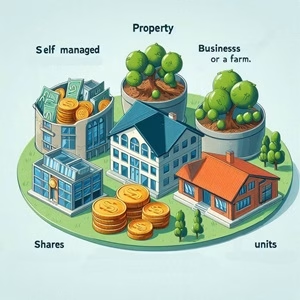
One of the most common reasons a self-managed superannuation fund uses an LRBA is to acquire property, which from 10 August 2026 can only be business real property. Other assets in the SMSF that can be single acquirable assets include shares, units and managed funds.
As per SMSFR 2012/1 “An asset is defined in subsection 10(1) to mean any form of property. In the context of an LRBA, an acquirable asset is therefore any form of property, other than money, that a trustee of an SMSF is not otherwise prohibited from acquiring.”
The single asset can include a property or a collection of identical assets such as a parcel of 1,000 Telstra shares. The parcel of Telstra shares becomes the single acquirable asset which must be treated in its entirety and cannot be partially sold or added to unless the shares are replacement assets (refer to discussion on replacement assets below). A portfolio of different shares or managed funds could not be managed within a LRBA.
Generally, a single acquirable asset which is a property is limited to one title. However, some circumstances allow more than one title.
The following examples are from ATO SMSFR 2012/1
Example 1 – two adjacent blocks of land
- As part of the investment strategy of an SMSF, the trustees of the SMSF want to acquire two adjacent blocks of land under a single LRBA. While the vendor will only sell the two blocks together, there are no physical or legal impediments to the two blocks of land being sold separately.
- The two blocks of land are not a single acquirable asset. As a result, the two blocks of land cannot be acquired under a single LRBA. However, the blocks of land could be acquired under separate LRBAs.
From 10 August 2026, any vacant land must meet the definition of business real property (BRP) to be an eligible asset an SMSF can acquire under an LRBA. However, it may be difficult to maintain vacant land as BRP unless it is leased for business use, such as a car park.
Example 2 – a factory complex on more than one title
- A trustee of an SMSF wants to enter into an LRBA to acquire a factory which is constructed across three titles. The existence of the factory adds considerably to the value of the land and thus is a significant part of the value of the asset. The factory is therefore relevant as a unifying physical object.
- The factory and the land comprised of the three titles, is a single acquirable asset and can be acquired under a single LRBA.
- However, if the factory was derelict and thus not of significant value relative to the land this asset could not be acquired under a LRBA as the factory is not relevant as a unifying physical object and thus the assets are the three titles.
A LRBA involves a SMSF trustee borrowing money which:
- must be used to acquire an asset which immediately rules out existing assets of the fund
- can be used to replace an asset BUT this is very limited in the application of the rules
- can be used to pay the purchase price plus borrowing and acquisition expenses
- cannot be used to improve an asset
- can be used for repairing and maintaining an asset
Held on trust
The asset is required to be held by a separate holding or bare trust which is known as the custodian. The trustee of the custodian holds the title of the asset on behalf of the SMSF. The trustee of the custodian cannot be the trustee of the SMSF as you cannot hold an asset in trust for yourself. The custodian can be another company or an individual. Provided the custodian is not trading or have other income in its own right it is not required to have a tax file number, lodge tax returns, prepare financial statements or be registered for GST.
One bare trustee can act as trustee for multiple bare trusts.
The SMSF is responsible to account for income and expenses in relation to the asset held under the LRBA If GST is applicable, it is payable by the SMSF. Land tax is payable by the SMSF but is actually levied on the custodian. The borrowing is usually made in the name of the SMSF and not the custodian with all loan repayments made by the SMSF. However, in very rare cases it may be possible to set up an intermediary LRBA where the custodian borrows using the asset as security, but the loan is paid by the SMSF.
If the asset is a property, the custodian would be named as the landlord on the lease and be the owner in relation to council and water rates and be registered as the owner in relation to land titles in the appropriate state. Please refer to our guide under SMSF Borrowing Resources page for more information on bare trusts and stamp duty requirements which vary in each state.
Advice from your SMSF Specialist is crucial before considering an intermediary LRBA. It would be wise to request a self-managed superannuation specific advice from the Australian Taxation Office before using this type of arrangement.
SMSF can acquire legal ownership
The SMSF has the right to obtain legal ownership of the asset. There is no requirement that the SMSF MUST obtain legal ownership, but they must have the right to do so if they want to. If the asset is a property, the custodian is not required to transfer the title until the loan is fully repaid. However, the property title does not have to be transferred at that time, but the property remains subject to the LRBA rules until it is transferred. This means the property could not be developed into something else. An example of this could be a vacant block of land. The SMSF could not build on it until the title was transferred from the custodian to the SMSF.
Recourse on the loan is limited
If the SMSF fails to repay the loan the lender’s rights are limited to the asset held in relation to the LRBA. The agreement is structured so that the lender is unable to call upon the other assets held within your SMSF.
Additional protection can be provided via an external guarantee for the loan such as a personal member’s guarantee, but the member must specifically waive their right to pursue the fund in the case of a default. The SMSF assets cannot be compromised by the guarantee.
Permitted Assets
The SIS legislation generally allow acquisition of a variety of assets. However, it does restrict certain assets which are owned by a member or related party or leased to a related party. Most SMSF trustees purchase a property via a limited recourse borrowing arrangement.
it is possible to acquire the following from a SMSF member or related party with a LRBA used to purchase:
- commercial property (business real property asset)
- residential property, which is used as part of a business, but generally most residential property will not qualify
- vacant land, which is part of a business, but again most vacant land will not qualify
- listed equities
- managed funds which are listed on a stock exchange or are public managed funds
A SMSF can acquire units or shares in an ungeared unit trust or company (refer to “Unlisted Shares” under our resource page). However, it may be a lot more difficult to obtain a loan from a lending institution or possibly from a related party as the underlying asset owned is not able to be used for security. The asset subject to the LRBA is the shares or the units and most banks will not lend money under those circumstances.
Repairs and Maintenance
A LRBA in relation to purchasing a property can be used to undertake repairs and maintenance. The loan agreement must allow for a redraw to pay for repairs. A run-down property which needs repairs (careful it is not an improvement or changing the asset into something else) when it is initially acquired can be undertaken and paid from borrowings.
Improvements to SMSF Property
It is possible that a SMSF property investment purchased under a LRBA can be improved. However, money cannot be used from borrowings to improve the property. Improvements can be paid for from the fund’s bank account or possibly contributions.
The ATO have provided a table illustrating when repairs/maintenance contrasts with improvements.
Extracted from ATO SMSFR 2012/1
Farm on a single title
The farm is the single acquirable asset under an LRBA. At the time of entering into the LRBA the farm includes one set of cattle yards, four bores including windmills, tanks and troughs and three kilometres of fencing.
| Repair & Maintenance | Improvement |
| Replacing a section of the cattle yards or the existing fencing is a repair. Ensuring the bores, windmills, tanks and troughs continue working is repair or maintenance. This would include laying new pipes between the tank and trough to replace the old pipes. |
Each of the following additions is an improvement: •a further set of cattle yards. •a further bore, tank; windmill and trough. •a further dam. •a further shed. •a further two kilometres of fencing. |
A residential building
| Repairs & Maintenance | Improvement |
| A fire destroys a three bedroom residential house. Rebuilding a broadly comparable house is not an improvement as it restores the asset to what it was before the fire. If superior materials, fittings or appliances are used it is a question of degree as to whether the changes significantly improve the state or function of the asset as a whole. |
Rebuilding a residential house that is not broadly comparable to that destroyed is an improvement. However, if the funds to rebuild are from an insurance company and not from borrowings this does not affect the LRBA. |
Machinery or Equipment
| Repairs & Maintenance | Improvement |
| An item of earth moving equipment is acquired under an LRBA. Immediately after its acquisition money borrowed under the LRBA is used to fund repairs to the hydraulic system of the asset to return it to its full functionality. This would be a repair. | A major overhaul of the asset is carried out with all significant parts of the asset being replaced. This is likely to be an improvement on the basis that the changes have significantly improved the state or function of the asset. |
SMSF Borrowings and Replacement Assets
A LRBA continues to comply with the borrowing rules if the single acquirable asset is replaced under specific limited circumstances.
Replacement assets are limited to an original collection of shares in a company (ie a parcel of 1,000 Telstra shares) or a collection of units in a unit trust (ie a parcel of 2,500 units in BT Technology Retail Fund) which are subject to takeover, merger, demerger or restructure of the company or unit trust.
When an asset is acquired by a SMSF using a LRBA the fundamental character of the asset cannot be changed in such a way as to replace the asset with a different asset. Changing the character of the asset would fail the borrowing provisions. Improving an asset does not create a replacement asset.
Examples of real property which is fundamentally changed include:
- developing vacant land by building a residence on it
- subdividing land and building another house on one of the blocks
- knock down an existing old house and replacing with 6 commercial units
- a residential house is converted into a restaurant with significant renovations such as fitting out a commercial kitchen, building public restrooms, putting in a car park, knocking down walls to fit out restaurant tables and chairs which changes the residence to fully functioning restaurant
Dividends flowing from shares which are owned by a custodian cannot be reinvested by the custodian but could be paid in cash and banked into the fund’s bank account. Reinvesting the shares would change the single acquirable asset being the block of original shares into a different parcel of shares and would breach the borrowing rules.
The following example shows how insurance proceeds used to rebuild do not change the character of the asset and is not considered to be a replacement asset.
Extracted from ATO SMSFR 2012/1
| Residential house and land | A fire destroys a four bedroom house and a new superior residential house is constructed on that land using both insurance proceeds and additional SMSF funds. Rebuilding another residential house (whether of the same size or larger) does not fundamentally change the character of the asset held under the LRBA. The addition of a garage, for example, would also not change the character of the asset. |
Related Party Borrowing by SMSF Trustees
The SIS legislation does not have any additional restrictions on a related party providing a SMSF loan for a LRBA apart from ensuring the loan terms must be commercial. The ATO has issued Practical Compliance Guideline PCG 2016/5, also known as “safe harbour guidelines,” which can serve as a template for the loan agreement between the SMSF and the related party. While the SMSF is not obligated to follow these guidelines, obtaining other external evidence of appropriate terms and conditions can be challenging.
The safe harbour guidelines relate to borrowings used to acquire property or listed shares and units. Generally, the ATO and the auditor will be satisfied if the guidelines are followed. The guidelines include the following:
Safe Harbour Guidelines
| Real Property | Listed Securities | |
| Interest rate for 2025 financial year based on RBA and the interest rates are subject to changes annually | 9.25% | 11.25% |
| Fixed/Variable | Can be fixed initially for a maximum of 5 years. Otherwise the rate is variable | Can be fixed initially for a maximum of 3 years. Otherwise the rate is variable |
| Terms of the loan | 15 year maximum loan term (for both residential and commercial) | 7 year maximum loan term |
| Loan to Market Value Ratio (LVR) | Maximum of 70% | Maximum of 50% |
| Security | Registered mortgage over the property | A registered charge/mortgage or similar security – possibly use Personal Property Securities Register |
| Nature & frequency of repayments | Repayments monthly being principal and interest | Repayments monthly being principal and interest |
| Loan agreement | Written and executed | Written and executed |
This guideline does not apply to borrowings used to acquire assets which are not property or listed equities. Therefore, the SMSF trustee must provide supporting evidence that the terms and conditions of the loan are in line with commercial standards and could be offered by a lending institution for that specific loan. The most reliable way to do this is by applying for the loan and obtaining confirmation of the terms and conditions, which can then be documented in a loan agreement with a related party lender.
Tips and Traps for Self Managed Super Fund Borrowing
- Ensure all transactions are made on an arms length basis to avoid non arms length income (NALI) which can be triggered by low or nil interest rate included in a related party loan agreement. Income from the underlying asset and the capital gain on disposal could be taxed at 45%.
- An LRBA can be refinanced – refer to your SMSF Specialist or Licensed Financial Adviser for details.
- Vendor finance can be considered provided it meets the SIS requirements.
- Consider the sole purpose test and ensure the asset being acquired is to provide benefits for the member’s retirement or death.
- Review and update the fund’s investment strategy,
- The trust deed must allow the SMSF trustee to borrow money to buy a property or other permitted asset. In some old deeds a SMSF may not be allowed to borrow, and custodian arrangements may not be allowed.
- An individual’s total superannuation balance (TSB) is the sum of the value of all of their superannuation interests, including both accumulation and pension balances. The TSB affects such things as the eligibility of a member to make non concessional contributions and utilise the remainder of their carried forward unused concessional contributions. A proportion of the outstanding loan balance under an LRBA can be included in the member’s TSB if the LRBA was entered into after 1 July 2018 and the loan is from a related party or the member has satisfied a full condition of release (ie reached age 65).
- If the asset is shares or managed funds the custodian should hold the parcel under a separate and unique HIN (or investor number) held on behalf of the SMSF to distinguish the parcel from other assets it may own.
Key Takeaways
- Short-term borrowing up to 10% of the value of the fund’s total assets to cover the settlement of security transactions
- Borrow to settle a benefit payment
- SMSFs can borrow using a LRBA to purchase property, which from 10 August 2026 can only be business real property, listed securities and other assets
- The asset must be a single acquirable asset
- The asset is required to be held in the separate trust (custodian)
- Recourse by the lender is limited to the asset subject to the LRBA when a loan default occurs
- Repairs and maintenance can be paid from borrowings
- Improvements can be made to a property subject to a LRBA but must be paid by the SMSF as the improvements cannot be paid from borrowings
- Replacement assets are prohibited except under limited circumstances
- A loan can be made by an external lending institution or by a related party
- A related party loan involves an SMSF trustee taking out a loan agreement with commercial terms and conditions
Do you need help with understanding SMSF Borrowing Rules?
Give us a call on 1300 392 544 or get in touch online